The future of climate scenarios is already being reshaped.
The climate science community is already preparing the IPCC's Seventh Assessment Report (AR7).
Alongside it comes a major evolution: CMIP7.
Behind this technical acronym lies something fundamental.
CMIP simulations underpin a large share of today's climate analyses. They support global warming projections, climate risk assessments, hydrological modeling, financial stress testing, and climate adaptation strategies.
Whenever a company, a public authority, or an insurer talks about the "future climate", there is usually a CMIP dataset behind the analysis.
But CMIP7 is much more than a simple update to CMIP6. The scientific community is addressing several limitations identified during the AR6 cycle in order to produce scenarios that better reflect today's real-world trajectories.
This is likely one of the most significant developments in climate modeling in recent years.
The Coupled Model Intercomparison Project (CMIP) coordinates the climate models used by leading scientific institutions and by the IPCC.
Each new generation improves the representation of Earth's climate system through more realistic ocean-atmosphere interactions, better biosphere modeling, more consistent emissions pathways, and increasingly detailed climate projections.
CMIP5 provided the foundation for AR5. CMIP6 supported AR6. CMIP7 will underpin the next IPCC assessment report, AR7.
Over time, several criticisms emerged regarding CMIP6.
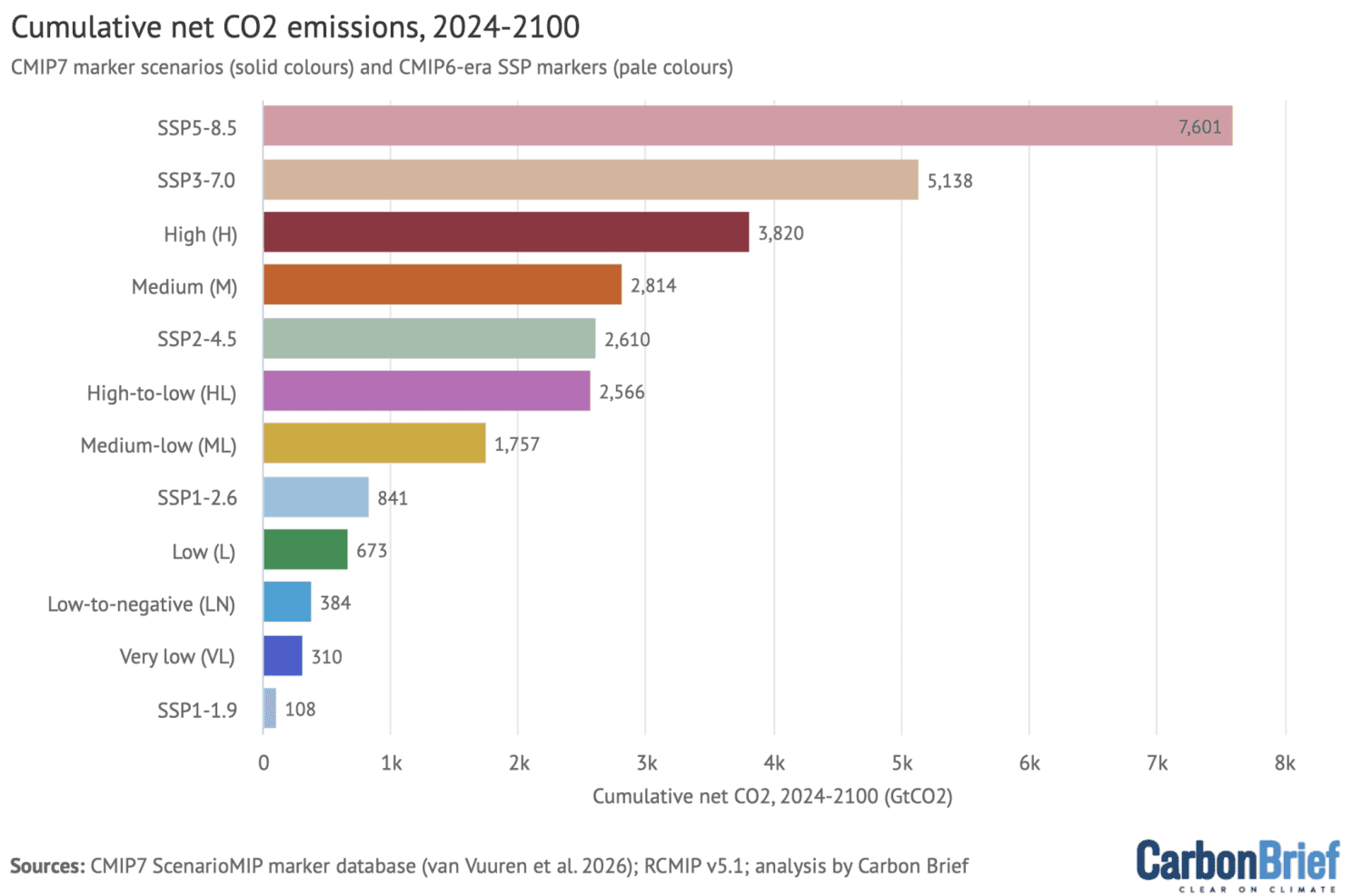
The most widely discussed concerns some of the highly extreme scenarios, particularly SSP5-8.5.
For years, this scenario was extensively used in research and climate risk assessments. It described a world characterized by rapidly increasing fossil fuel consumption, limited climate action, and extremely high greenhouse gas emissions.
However, as energy policies, technological developments, and economic trends evolved, many researchers began to view this pathway as increasingly unlikely.
This is where CMIP7 introduces a major shift. The concept of plausibility*becomes central.
The goal is no longer simply to explore every conceivable future. Instead, it is to better distinguish realistic trajectories from scenarios that primarily serve as extreme stress-testing exercises.
Importantly, this does not mean climate change is considered less severe.
Rather, the objective is to provide more robust scenarios for decision-making.
One of the most important changes in CMIP7 concerns how climate simulations are constructed.
In CMIP6, many simulations were driven by prescribed atmospheric greenhouse gas concentrations.
CMIP7 places greater emphasis on emissions-driven simulations, where future emissions are used directly as model inputs.
While this may sound like a technical adjustment, the implications are substantial.
This approach allows models to better represent key Earth system feedbacks, including ocean carbon uptake, potential weakening of forest carbon sinks, droughts, wildfires, permafrost thaw, and ecosystem saturation.
In other words, climate outcomes emerge more naturally from the interactions within the Earth system rather than being constrained by predefined atmospheric concentrations.
This is arguably the most important scientific evolution between CMIP6 and CMIP7.
The structure of climate scenarios is also changing.
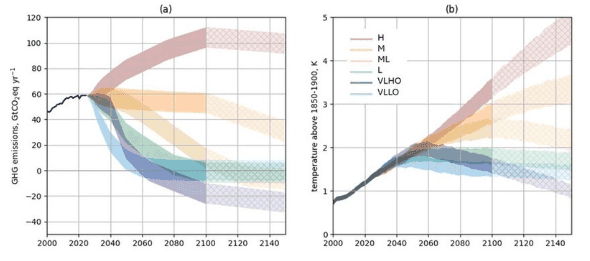
The familiar labels such as SSP1-2.6 or SSP5-8.5 will gradually be replaced by simpler categories including High, Medium, Low, and Very Low.
This simplification addresses a practical challenge: making climate scenarios easier to understand and communicate to policymakers, businesses, investors, and local authorities.
The Medium scenario is particularly interesting.
It broadly reflects a continuation of current policies and trends.
In other words, CMIP7 suggests that the most plausible future today lies somewhere between climate inaction and a perfectly successful transition compatible with the Paris Agreement.
Climate policies continue to advance, but not yet at a pace sufficient to fully meet global climate objectives.
CMIP7 also places much greater emphasis on overshoot scenarios.
These scenarios explore futures in which global warming temporarily exceeds thresholds such as 1.5°C or even 2°C before stabilizing or declining.
This may actually represent one of the most realistic pathways for the coming decades.
Temporary overshoot could be followed by large-scale emissions reductions and the deployment of carbon dioxide removal technologies.
However, even temporary exceedance can have profound consequences.
Glaciers, water resources, ecosystems, and certain climate extremes may experience irreversible impacts long before temperatures stabilize.
Another major change is the extension of simulation time horizons.
Some CMIP7 projections will extend to 2150 and even 2500.
Why look so far ahead?
Because many components of the climate system evolve over very long timescales.
Sea-level rise, ocean circulation, and ice-sheet dynamics can continue changing for centuries after temperatures stabilize.
CMIP7 therefore seeks to answer a question that is becoming increasingly important:
Which climate changes are reversible, and which may become effectively permanent on human timescales?
These developments are not only relevant to climate scientists.
Future climate risk assessments will gradually incorporate these new scenarios.
This could influence stress-testing frameworks, adaptation assumptions, regional projections, and investment strategies.
Sectors such as water management, insurance, energy, agriculture, infrastructure, and finance are likely to be particularly affected.
For adaptation planning, this evolution is especially important.
Organizations increasingly need scenarios that are not only scientifically robust but also operationally useful.
CMIP7 represents a new stage in the maturity of climate modeling.
For decades, the primary objective was to map the full range of possible futures.
Today, the challenge is evolving.
Scientists are increasingly focused on identifying the most plausible futures, improving the representation of Earth system feedbacks, and producing climate information that directly supports decision-making.
In many ways, climate science is moving from a world of "possible futures" toward a world of "credible futures."
And that may be exactly what makes CMIP7 so important for the years ahead.
CMIP7 and CMIP6 are two successive generations of climate model intercomparison projects used by the IPCC to produce global climate projections. The main difference lies in the evolution of both the scenarios and the modeling framework. CMIP7 places greater emphasis on emissions-driven simulations, improves the representation of Earth system feedbacks, and introduces a new set of climate pathways that are considered more plausible than some of the extreme scenarios used in CMIP6. These advancements are designed to provide more robust projections for climate risk assessments and adaptation planning.
CMIP7 is gradually replacing the SSP framework to make climate scenarios easier to interpret and more closely aligned with plausible future trajectories. While scenarios such as SSP5-8.5 played an important role in climate research and risk analysis, many scientists now consider them increasingly unlikely based on current energy trends, technological developments, and climate policies. CMIP7 introduces a simplified set of scenarios (High, Medium, Low, Very Low) that are easier to communicate and better reflect realistic future pathways.
CMIP7 is expected to improve the accuracy and relevance of climate risk assessments used by businesses, insurers, investors, and public authorities. By better representing carbon cycle feedbacks, extreme events, and overshoot pathways, the new generation of climate scenarios provides projections that are more consistent with the physical behavior of the Earth system. This will help organizations refine their assessments of risks related to floods, droughts, heatwaves, water resources, and infrastructure, while strengthening long-term climate adaptation strategies.
New CMIP7 scenarios: what climate futures can we expect by 2100?
9/21/2026
Soil drought: where does summer 2026 really stand?
9/10/2026
Adapting Regional Transport Networks to Climate Change: From Assessment to Action
9/3/2026

Data center: integrating future climate into site selection
8/24/2026
How much will climate risk really cost?
6/29/2026
