Nearly one in three flood events in France involves coastal areas. Yet the risk of coastal flooding remains largely underrepresented in models.
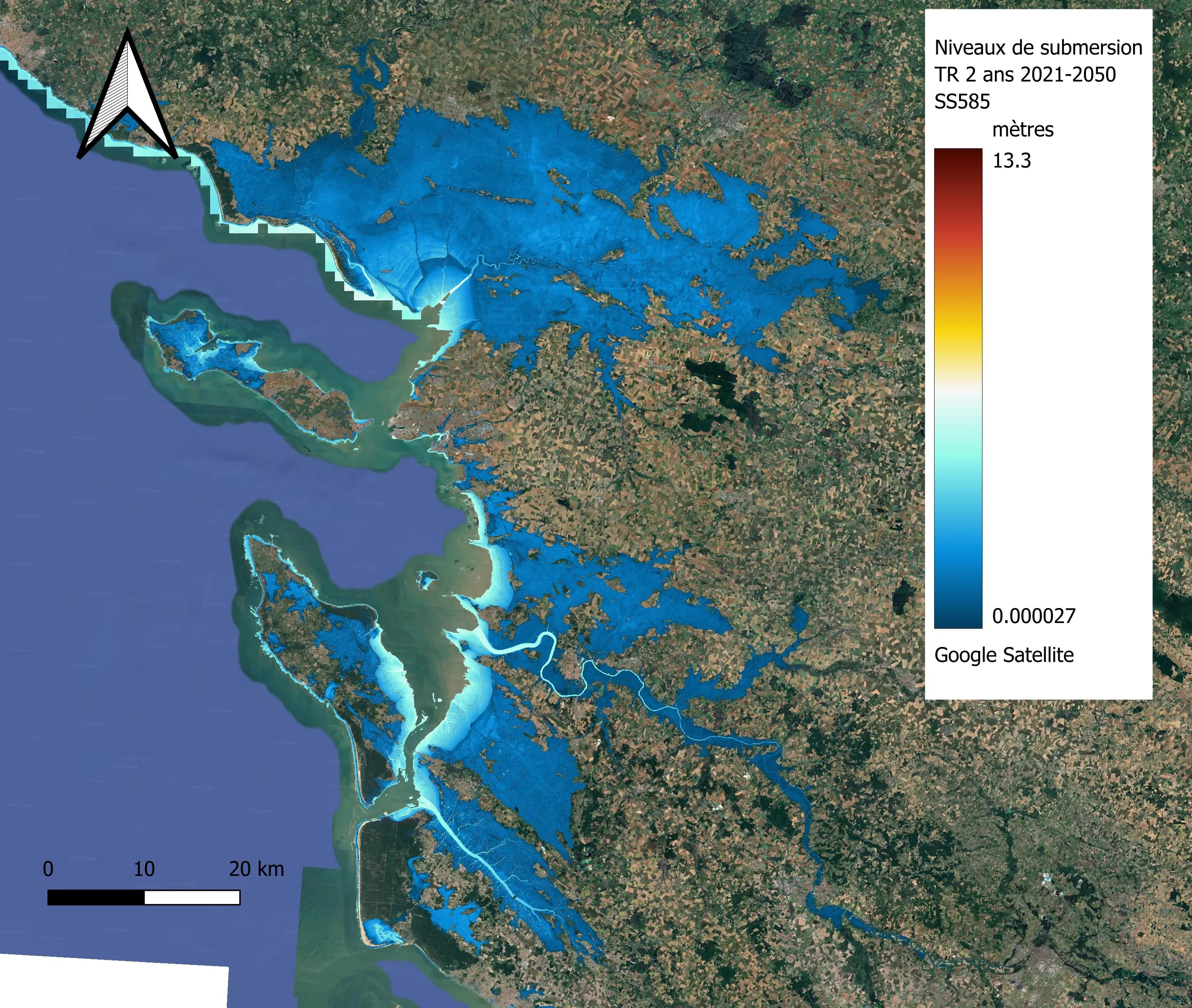
Coastal flooding is a major hydro-meteorological hazard whose importance is often underestimated in climate risk assessments.
According to the HANZE database (Paprotny, 2024), nearly one-third of all flood events recorded in France between 1950 and 2020 had a coastal component. These events can generate significant economic losses, as illustrated by Storm Xynthia (2010), which resulted in approximately €660 million in insured losses, and the October 1987 storm, which caused nearly €1.5 billion in damages. Both events were covered under the French CAT NAT natural disaster scheme, according to CCR (Caisse Centrale de Réassurance).
These figures confirm that coastal flood risk is already a key concern for the insurance sector.
In a context of climate change, the central question becomes: how will this risk evolve by 2050?
Climate change is expected to significantly affect insurers’ liabilities through an increase in claims associated with weather-related hazards, whether extreme or recurring, such as floods.
This evolution is driven by two simultaneous dynamics:
In this context, risk models historically based on past observations are showing their limitations. They do not always capture future changes in hazards or their impacts on insurance portfolios.
To address this challenge, Covéa Group, in collaboration with Hydroclimat, conducted a study aimed at projecting the evolution of coastal flood risk in France by 2050.
Presented at EGU 2026 by Morgane Terrier, Adrien Lambert, Magali Troin, and Benjamin Poudret, this research forms part of a broader effort to integrate climate projections into insurance risk analysis.
The study has two main objectives:
The goal is no longer simply to describe risk as observed in the past, but to project it within a changing climate while accounting for associated uncertainties. This approach represents a significant shift for the industry: moving from a retrospective view of climate risk to a prospective and integrated one.
The methodology relies on an integrated modelling framework designed to consistently link climate change projections with insurance impacts.
First, CMIP6 climate projections are used to characterize future meteorological and marine conditions by 2050. These projections help assess potential changes in sea levels, storm activity, and storm surge conditions.
This information then feeds a hydro-geomorphological modelling framework used to simulate the spatial extent of coastal flooding. This step is essential for translating climate signals into realistic flood footprints while accounting for local coastal characteristics such as topography, geomorphology, and existing protection infrastructure.
In a third step, hazard maps are combined with a national residential building database provided by Covéa. This allows the analysis to move beyond the physical phenomenon itself and toward a risk-based assessment by quantifying:
This integrated approach transforms climate signals into an operational assessment of financial risk.
It is particularly valuable for the insurance sector because it directly links climate projections to portfolio impacts, supporting decisions related to risk management, pricing, and adaptation strategies.
More broadly, this type of framework reflects a broader evolution in climate risk practices: moving beyond hazard analysis toward the quantification of economic consequences in a coherent and actionable way.
The results indicate a clear trend: an increase in the number of buildings exposed to coastal flooding, accompanied by a rise in potential insured losses.
This evolution is driven by both changing climate conditions (sea-level rise and evolving storm patterns) and the increasing concentration of assets in coastal areas.
However, beyond this overall increase, the structure of the risk itself is changing:
The risk is therefore not simply increasing—it is evolving both spatially and temporally.
This transformation has direct implications for the insurance industry and requires:
More broadly, these findings highlight the need to move from a static, historical view of risk toward a dynamic and forward-looking approach that integrates ongoing climate system changes.
This work illustrates a deeper transformation in the way climate risks are assessed. The focus is gradually shifting from general and descriptive climate analyses toward detailed impact quantification that can be directly used by economic stakeholders.
The challenge is no longer simply to characterize hazards, but to translate their consequences into tangible risks, including asset exposure, potential losses, and territorial vulnerabilities.
For the insurance sector, this evolution is particularly significant. The objective is no longer only to understand climate dynamics but also to anticipate their consequences for:
Integrated approaches combining climate projections, physical modelling, and business-specific data are becoming essential for managing risk in an uncertain environment.
They make it possible to:
More broadly, this represents a paradigm shift: climate risk is no longer viewed as a poorly constrained external factor but as a core parameter of decision-making.
Coastal risk provides a clear example. It is not a future risk—it is already present today, and its intensity, frequency, and spatial distribution will continue to evolve.
The challenge now is to fully integrate it into risk management tools and strategic decision-making processes.
Coastal flooding, also known as marine inundation, occurs when seawater temporarily floods coastal areas. It can result from a combination of storm surges, high tides, waves, and sea-level rise. In France and many other coastal regions worldwide, coastal flooding represents a major climate-related hazard capable of causing significant damage to buildings, infrastructure, and economic activities.
Climate change is contributing to rising sea levels and may influence the intensity and frequency of certain coastal extreme events. As a result, more properties and infrastructure could become exposed to marine inundation in the coming decades. Climate projections help assess how coastal flood risk may evolve by 2050 and beyond, supporting long-term adaptation and resilience planning.
Historical observations alone are no longer sufficient to estimate future climate risks. Insurers increasingly combine climate projections, coastal flood models, and exposure data to evaluate future losses and understand how risk may evolve over time. This approach helps improve risk assessment, portfolio management, pricing strategies, and climate adaptation planning in coastal areas.
New CMIP7 scenarios: what climate futures can we expect by 2100?
9/21/2026
Soil drought: where does summer 2026 really stand?
9/10/2026
Adapting Regional Transport Networks to Climate Change: From Assessment to Action
9/3/2026

Data center: integrating future climate into site selection
8/24/2026
How much will climate risk really cost?
6/29/2026
