Whether a bank is conducting a climate stress test, an insurer is assessing its exposure to natural hazards, or an investor is evaluating climate-related risks, one reference framework is used time and again: the NGFS scenarios. However, these scenarios are now undergoing a major evolution.
When a bank conducts a climate stress test, an insurer assesses its exposure to natural hazards, or an investor evaluates transition risk, one framework almost always comes up: the Network for Greening the Financial System (NGFS) climate scenarios.
Over the past few years, these scenarios have become the international benchmark for climate risk assessment in the financial sector. Yet they are undergoing a profound transformation. Their purpose is no longer limited to projecting the climate in 2050 or 2100. They now aim to quantify the economic and financial impacts of climate change over much shorter time horizons, making them directly relevant for today's decision-making.
The question therefore becomes much more practical:
How will climate change affect the economy, financial assets, investment portfolios, and the stability of the financial system over the coming years?
This is precisely what the latest generation of NGFS scenarios seeks to answer.
The Network for Greening the Financial System (NGFS) now brings together more than 152 central banks and financial supervisors worldwide. Its mission is to integrate climate and environmental risks into financial supervision, risk management, and economic policymaking.
Its climate scenarios have become the global reference for climate stress testing, but their role is evolving. They are no longer designed solely to describe long-term climate trajectories. They are increasingly becoming macro-financial decision-support tools.
NGFS scenarios are not forecasts. Instead, they describe a range of plausible futures designed to test the resilience of economies and financial institutions under different transition pathways and levels of global warming.
Their greatest strength lies in their ability to connect three dimensions that have traditionally been analysed separately: climate, the economy and the transition policies.
They seek to understand how rising temperatures, droughts, floods, or climate policies propagate through the real economy and the financial system.
These events can affect economic growth, inflation, investment dynamics, asset valuations, credit risk; and ultimately financial stability. This integrated approach makes NGFS scenarios particularly valuable for financial institutions.
A bank does not finance an average temperature. An insurer does not insure an emissions pathway. An investor does not value a climate scenario. What ultimately matters is how climate change translates into economic and financial consequences. This is precisely where NGFS scenarios provide their greatest value.
Phase IV of the NGFS scenarios, analysed in particular by the Banque de France, highlights one key finding. Delays in the transition are making the adjustment increasingly costly.
In France, under the Current Policies scenario, CO₂ emissions from the energy sector would decline by only 17% between 2020 and 2030.
In previous versions of the NGFS scenarios, this reduction was estimated at 27%. This gap illustrates a simple reality: the global economy is entering the transition with far less room for manoeuvre than previously anticipated. Achieving climate targets will therefore require faster, more concentrated, and potentially more expensive efforts.
Under the Net Zero 2050 scenario, the implied carbon price in France would reach €270/tCO₂ by 2030, rising to €910/tCO₂ by 2050 (in constant 2020 euros).

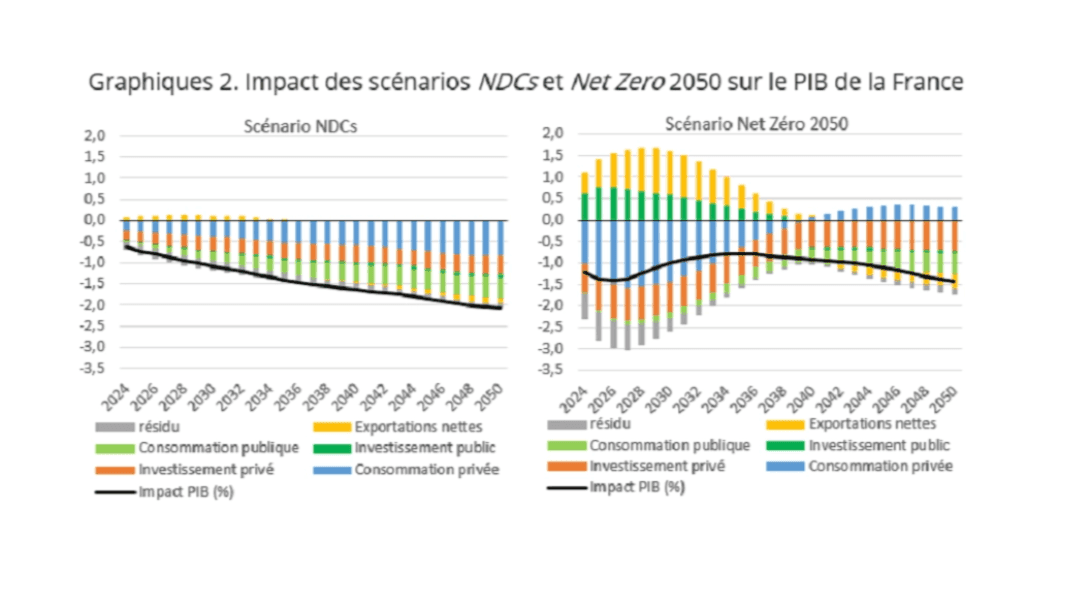
Figure 1. Evolution of the implied carbon price under the NGFS scenarios and associated impacts on French GDP. Source: Banque de France (2025).
This figure should not be interpreted as a forecast of future carbon taxes. Rather, it represents the scale of the economic effort required to keep the transition pathway consistent with carbon neutrality.
This sends a strong signal to financial institutions. The longer the transition is delayed, the more abrupt it becomes. And the more abrupt the transition, the greater its potential impact on business models, profit margins, asset values, and the solvency of certain sectors.
One of the most robust conclusions emerging from the NGFS scenarios can be summarised in a single sentence:
The transition is costly in the short term, but inaction is even more costly in the long term.
According to the Banque de France, the Net Zero 2050 scenario would result in a temporary GDP loss of around 1.4% as early as 2025, compared with a hypothetical trajectory without climate risks or transition policies.
This decline mainly reflects the costs associated with adapting the economy and implementing emission reduction policies. However, these costs must be compared with those of a world where the transition remains insufficient.
By 2050:
The difference is substantial. The real question is therefore not simply how much the transition costs, but rather how much the absence of transition will cost.
For banks, insurers and investors, this distinction transforms climate change into a core issue for risk management, capital allocation and asset valuation.
While the first generations of NGFS scenarios focused primarily on transition risks, the latest versions place growing emphasis on physical risks. This evolution reflects an increasingly tangible reality: the impacts of climate change are no longer confined to long-term projections. They are already materialising through more frequent and more intense extreme weather events.
Droughts, heatwaves, floods and storms have direct consequences for the economy by affecting productivity, infrastructure, supply chains, agricultural yields, insurance costs and, more broadly, the continuity of economic activity.
Under the Current Policies scenario of the NGFS Phase IV framework, the projected economic losses for France clearly illustrate the growing importance of physical risks. Damages would primarily be driven by:

Figure 3. Contribution of different climate hazards to GDP losses under the "Current Policies" and "Net Zero" scenarios. Source: Banque de France (2025).
These results highlight that, in a context of insufficient climate policies, physical risks could become one of the main drivers of economic vulnerability over the coming decades. They also reinforce the need to integrate adaptation and resilience strategies alongside greenhouse gas emission reduction policies.
One of the most significant developments introduced by the NGFS is the publication, in 2025, of its Short-Term Climate Scenarios. Until recently, one of the main limitations of climate scenario exercises was their time horizon. The scenarios looked decades ahead, while financial decisions are typically made over three, five or ten years.
The new short-term scenarios are designed to bridge this gap. They assess the potential impacts of both physical and transition climate risks through 2030. This represents a major shift, as climate is no longer viewed solely as a long-term balance sheet risk. It is becoming a business cycle risk.
A severe climate shock, a delayed transition or a combination of extreme events can now be tested over time horizons that are directly relevant to risk departments, financial supervisors and investment committees.
This evolution reflects the NGFS's ambition to bring climate analysis closer to today's economic and financial realities by making climate risk a fully integrated component of short-, medium- and long-term risk assessment.
The results published by the Banque de France illustrate the power of these new tools. Under a scenario simulating a sequence of extreme climate events across Europe, France could experience a 7.4% loss in GDP.

Figure 4. GDP impact of NGFS short-term scenarios simulating extreme climate events in 2026 and 2027. Source: Banque de France (2025).
The scenario assumes a series of heatwaves, droughts and wildfires in 2026, followed in 2027 by a combination of floods and storms across Europe.
This type of scenario is not intended to predict the future. Its purpose is to test the resilience of the economic and financial system against a plausible shock. That is precisely what makes it valuable.
For a financial institution, a short-term climate shock may translate into higher default rates, declining collateral values, increased insurance claims, lower profitability or corrections in asset prices. Climate risk therefore becomes comparable to other major financial risks. It can now be stress-tested, quantified and incorporated into decision-making.
For financial institutions, such a scenario may result in:
This approach reflects a major shift: climate risk is no longer simply an environmental or long-term issue. It has become a fully-fledged financial risk that can be quantified, stress-tested and integrated into risk management and decision-making processes.
The development of NGFS scenarios reflects a major shift: climate is gradually becoming part of the language of finance. For insurers, this means anticipating how claims may evolve in the future. For banks, it means assessing the exposure of their loan portfolios to both physical and transition risks. For investors, it means evaluating how different climate pathways may affect the future value of their assets. NGFS scenarios now provide a common framework for addressing these challenges through comparable and quantifiable indicators.
The latest generation of scenarios translates the impacts of climate change into variables that can be directly used by financial institutions: GDP growth, inflation, investment, carbon prices, cost of capital, sectoral exposure, as well as physical and transition risks.
This translation is essential. Financial decision-makers do not simply need to know that the climate is changing; they need to understand how these changes will affect their risks, assets, liabilities and strategies. NGFS scenarios are therefore no longer just scientific tools. They are becoming genuine decision-support and governance tools.
In particular, they help answer practical questions such as:
As climate risks continue to materialise, the ability to answer these questions is becoming a key component of financial risk management and organisational resilience. Today, NGFS scenarios represent one of the leading frameworks for integrating climate considerations into economic and financial decision-making.
NGFS scenarios have become the benchmark for climate risk assessment. They provide a consistent framework for analysing the interactions between climate, the economy and the financial system. However, they do not answer every question faced by financial institutions.
A bank, insurer or investor does not only need to understand how the economy may evolve at the national level. They must also be able to identify precisely which assets are exposed, which climate hazards may affect them, how vulnerable they are, and how that vulnerability evolves under different climate horizons. This challenge is particularly important when assessing physical risks.
Indeed, macroeconomic estimates of losses associated with droughts, heatwaves or floods cannot, on their own, identify the most exposed industrial facilities, vulnerable critical infrastructure, water catchments under pressure or real estate portfolios facing the highest levels of risk.
Bridging the gap between macroeconomic scenarios and operational decision-making therefore requires more detailed, spatially explicit climate data that accurately reflects local conditions. It also relies on sector-specific indicators capable of translating climate projections into information that can be directly used for risk management, investment and insurance decisions.
This is precisely where high-resolution climate data becomes essential. NGFS scenarios provide a macroeconomic and financial perspective on climate change, while localised climate data identifies the assets that are actually exposed, characterises local vulnerabilities and assesses the intensity of the physical risks likely to affect portfolios.
Rather than competing with one another, these two approaches are complementary. NGFS scenarios provide a global view of climate risk trajectories, while high-resolution climate data translates these trajectories into concrete analyses that directly support decision-making. Connecting macroeconomic scenarios with detailed territorial information has become one of the key challenges in climate risk assessment.
For financial institutions, the new NGFS scenarios fundamentally change the way climate risk is understood. They show that climate risk is no longer solely an environmental or reputational issue. It has become a fully-fledged economic and financial risk, capable of affecting economic growth, inflation, financing costs, insurance claims, asset valuations and portfolio stability.
They also show that the time horizon of climate risk is moving closer. Climate is no longer just an issue for 2050; it is becoming an issue for 2030 and, in some cases, for the next few years. This evolution requires a change in methodology. Having a general climate pathway is no longer sufficient. Today, institutions must be able to connect scenarios to actual exposures, link macroeconomic models with physical climate data, and transform the results into indicators that can be directly used by risk, insurance, investment and strategy teams.
In this context, the challenge is no longer simply to understand future climate pathways, but to assess their potential consequences for assets, financed activities and portfolio resilience in practical terms. NGFS scenarios therefore provide an essential framework for progressively integrating climate risk into financial decision-making and risk management processes.
NGFS scenarios represent a new stage in the maturity of climate risk analysis. The first step was recognising that climate change constitutes a financial risk. The second was establishing a common framework enabling central banks, supervisors and financial institutions to assess these risks consistently. The next step is now to make these scenarios fully operational.
This evolution implies a genuine shift in perspective. It is no longer simply about meeting regulatory requirements or carrying out compliance exercises. Climate scenarios are gradually becoming decision-support tools that can inform investment decisions, financing strategies, risk management and capital allocation.
However, their true value lies not only in the pathways they describe, but also in the questions they allow decision-makers to ask.
→ How much does inaction cost?
→ Over what time horizon could climate risks materialise?
→ Which sectors are the most vulnerable?
→ Which regions concentrate the highest physical risks?
→ How can this information be integrated into financing, insurance and investment decisions?
For many years, financial institutions have been asking how climate should be incorporated into their risk models. The latest NGFS scenarios reflect a fundamental shift in perspective. The question is no longer whether climate change should be integrated into financial decision-making. The real question is now with what level of precision, at what spatial scale and over which time horizons climate information should be incorporated to improve risk assessment and strengthen portfolio resilience.
In this context, the future of climate stress testing will increasingly rely on combining macroeconomic scenarios, high-resolution climate data, and asset-level exposure analyses. Only by bringing these three dimensions together can climate scenarios fully fulfil their role as decision-support and risk management tools for the financial sector.
NGFS Climate Scenarios for Central Banks and Supervisors – Phase IV (2024)
NGFS Short-Term Climate Scenarios (2025)
Banque de France, New NGFS Phase IV scenarios: Economic impacts for France
Banque de France, NGFS short-term climate scenarios: Results for France
NGFS Scenario Explorer
The Network for Greening the Financial System (NGFS) scenarios are climate scenarios developed to help central banks, financial supervisors and financial institutions assess climate-related risks. They combine climate projections, economic assumptions and transition policy pathways to analyse the potential impacts of climate change on economic growth, financial assets, investment portfolios, credit risk and financial stability. Today, they serve as the international reference framework for climate stress testing and climate risk assessment.
Physical risks refer to the direct impacts of climate change, such as floods, droughts, heatwaves and storms, which can affect infrastructure, businesses and financial assets. Transition risks arise from the shift to a low-carbon economy and include climate policies, changing market conditions, technological innovation and carbon pricing. NGFS scenarios assess both categories of risk simultaneously, providing financial institutions with a comprehensive framework for climate risk management.
NGFS scenarios provide a macroeconomic perspective on the impacts of climate change, but they cannot accurately identify the assets or locations that are most exposed. High-resolution climate data complements these scenarios by mapping climate hazards, assessing infrastructure vulnerabilities, and quantifying physical risks at the asset level. Together, they enable banks, insurers and investors to perform more precise climate risk assessments and make better-informed investment, insurance and financing decisions.
New CMIP7 scenarios: what climate futures can we expect by 2100?
9/21/2026
Soil drought: where does summer 2026 really stand?
9/10/2026
Adapting Regional Transport Networks to Climate Change: From Assessment to Action
9/3/2026

Data center: integrating future climate into site selection
8/24/2026
Global scoring: turning climate data into decision-support indicators
6/22/2026
