Three of the five summers with the driest soils in France since 1958 have occurred in the past five years.
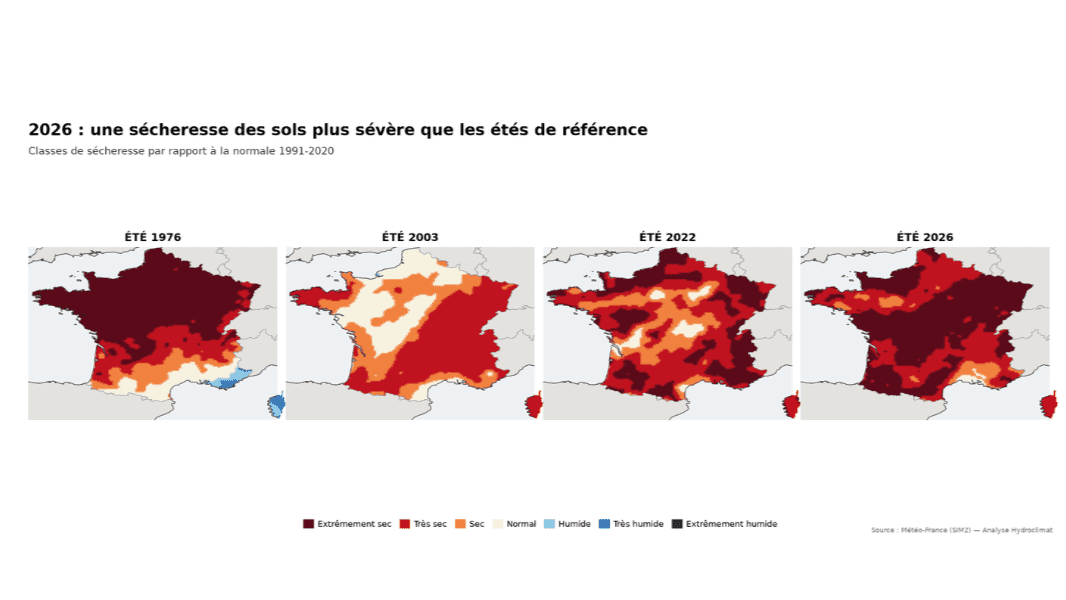
The 2026 meteorological summer has now come to an end, and the available data provide an initial overview of soil conditions across France.
This summer was marked by persistent anticyclonic conditions, a precipitation deficit of around 40%, and three successive heatwaves. Together, these conditions were particularly conducive to soil drying. Météo-France now describes the soil drought observed in 2026 as unprecedented at the national scale.
Our analysis of SIM2 data provides further insight: over the summer as a whole, average soil moisture in France was 49% below the 1991–2020 normal.
This deficit places 2026 first among the summers with the driest soils in France since 1958, ahead of several major droughts that marked recent decades, including those of 1976, 2003 and 2022.
To better understand this situation, Hydroclimat analysed Météo-France SIM2 data using the Soil Wetness Index (SWI), comparing the intensity of soil drying, its evolution throughout the summer, and its geographical distribution.
1976, 2003 and 2022 are three benchmark years when discussing droughts in France. Yet these events did not follow the same dynamics or affect the same areas.
Comparing soil moisture conditions with the 1991–2020 normal helps place summer 2026 in this historical context.
In 1976, soil drought was particularly severe across a large part of northern France. In 2003, it affected the south and east of the country more strongly, while 2022 was characterised by severe drought across much of France.
In 2026, soil drought became widespread across the entire country, and more than one-third of France experienced soil drought levels during the summer that had never previously been observed.
What makes 2026 particularly notable is the extremely low values recorded at the national scale, especially from west-central to north-eastern France. Its geographical extent is also a defining feature.
The map provides a spatial overview of the drought, but on its own it does not explain how the situation developed over time. The daily evolution of the SWI provides a second perspective.
From the beginning of June, average soil moisture in 2026 was already below the median observed over the 1991–2020 period. The gap then widened progressively and, by the beginning of July, Météo-France reported conditions that had never previously been observed at that time of year on average across the country.
By early August, soil drought had reached an unprecedented level at the national scale, exceeding the previous minimum recorded in 2022. The return of rainfall during the second half of August then led to a slight improvement, without bringing soils sustainably back towards normal conditions.
Comparison with 1976, 2003 and 2022 also highlights different trajectories: while some historical droughts experienced phases of stabilisation or soil rewetting, 2026 stands out for the significant and persistent drying observed throughout the season.

Figure – Evolution of the average SWI in France during summer 2026, compared with benchmark droughts (1976, 2003 and 2022) and the 1991–2020 climatology.
The shaded areas represent the historical variability observed over the 1991–2020 period (P10–P90 and min–max). The 2026 curve shows the progressive decline in soil moisture and how it compares with the main benchmark droughts. Source: @Météo-France SIM2 – Analysis: @Hydroclimat.
This dynamic perspective is important because soil drought is not characterised solely by the minimum value reached. Its duration, the speed at which it develops and its persistence also determine its intensity and potential impacts.
The historical record makes it possible to assess more precisely just how exceptional this summer was.
When comparing average soil moisture for each summer since 1958, 2026 shows the lowest average SWI value across the entire series analysed. It therefore ranks ahead of 1976, 2022, 2003 and 2025.

Figure – Average soil moisture in France during the summers from 1958 to 2026.
The dotted line represents the 1991–2020 summer normal. The five summers with the lowest average SWI values are highlighted to place 2026 in the context of nearly 70 years of observations. Source: Météo-France SIM2 – Analysis: Hydroclimat.
Comparison with the 1991–2020 normal also illustrates the scale of the event: over summer 2026 as a whole, average soil moisture in France was around 49% below normal. But the ranking reveals another particularly important signal.
Of the five summers with the driest soils since 1958, three have occurred since 2022. In just a few years, 2022, 2025 and now 2026 therefore account for three of the lowest values observed in nearly seven decades of data.
Taken in isolation, summer 2026 represents an exceptional event. However, when placed in the context of nearly 70 years of data, it forms part of a broader trend.
An analysis of summer soil moisture anomalies since 1958 reveals an overall downward trend in SWI across France. The Sen’s slope is estimated at -0.014 SWI points per decade, with a 95% confidence interval entirely below zero. The Mann-Kendall test confirms that this downward trend is statistically significant (p = 0.034).

Figure – Evolution of summer SWI anomalies in France between 1958 and 2026. The trend estimated using Sen’s slope is -0.0014 SWI points/year [95% CI: -0.0026; -0.0001]. The Mann-Kendall test confirms a statistically significant downward trend (p = 0.034). Source: Météo-France (SIM2) – Analysis: Hydroclimat.
In other words, despite strong variability from one summer to another, the analysis reveals a long-term trend towards drier summer soils in France.
The concentration of recent events is particularly striking: three of the five summers with the lowest average SWI values since 1958 have occurred in the past five years: 2022, 2025 and 2026.
Precipitation is obviously a key component of drought, but it is not enough to describe the actual condition of soils.
The SWI provides a measure of available soil moisture by integrating the functioning of the water balance. Under high temperatures and strong evapotranspiration, soils can therefore remain dry for extended periods despite occasional rainfall events.
Summer 2026 now represents a new benchmark in France’s historical record. But the fact that it is exceptional today does not mean it will remain so in the climate of tomorrow.
The historic summer France has just experienced is only a glimpse of our future climate. Météo-France’s latest assessment shows that the extreme anomalies recorded this season, marked by unprecedented heatwaves and historic soil drought, foreshadow the normal conditions of the coming decades. If global emissions remain on the trajectory underlying the French government’s +4°C warming reference by 2100, what is currently considered an exceptional summer could become commonplace by the end of the century.
This is precisely why droughts can no longer be analysed solely on the basis of past events. Historical data make it possible to measure the changes already underway; climate projections make it possible to anticipate those that are still to come. For local authorities, water resource managers, infrastructure operators and the agricultural sector, this forward-looking perspective is becoming essential to design adaptation strategies today for the climate of tomorrow.
Source : Météo-France SIM2 – Analysis: Hydroclimat. Comparison with the 1991–2020 climatology.
Une vague de chaleur correspond à plusieurs jours durant lesquels les températures sont nettement supérieures aux normales de saison. Une canicule désigne un épisode de fortes chaleurs qui se prolonge de jour comme de nuit pendant au moins trois jours et atteint des seuils définis localement. Durant l’été 2026, la France a connu trois vagues de chaleur successives, qui ont contribué à l’assèchement exceptionnel des sols.
Lors d’une canicule, les températures élevées augmentent l’évaporation de l’eau contenue dans les sols et l’évapotranspiration de la végétation. Si ces pertes ne sont pas compensées par des précipitations suffisantes, l’humidité des sols diminue rapidement. En 2026, la succession de fortes chaleurs et le déficit de pluie ont ainsi favorisé un assèchement particulièrement marqué des sols en France.
La canicule est un épisode de températures très élevées qui dure plusieurs jours, tandis que la sécheresse correspond à un manque durable d’eau. Une sécheresse peut concerner les précipitations, l’humidité des sols ou encore les rivières et les nappes phréatiques. Les deux phénomènes peuvent se renforcer : les fortes chaleurs accélèrent notamment l’assèchement des sols.
Quelques épisodes de pluie ne suffisent pas toujours à mettre fin à une sécheresse des sols. Lorsque les températures restent élevées, une partie de l’eau peut rapidement repartir vers l’atmosphère par évaporation et évapotranspiration. L'intensité des précipitations, leur durée, l'état initial du sol et la végétation influencent également la quantité d'eau réellement disponible dans les sols.
Selon l’analyse réalisée par Hydroclimat à partir des données SIM2 de Météo-France, l’été 2026 présente l’humidité moyenne des sols la plus faible observée en France depuis le début de la série en 1958. Sur l’ensemble de l’été, elle a été environ 49 % inférieure à la normale 1991-2020. L’été 2026 se classe ainsi devant les sécheresses historiques de 1976, 2003 et 2022.
Le réchauffement climatique favorise l’intensification des sécheresses des sols en augmentant notamment l’évaporation et les besoins en eau de la végétation. En France, Météo-France observe déjà une augmentation de la fréquence et de l’intensité des sécheresses des sols. L’analyse Hydroclimat des données depuis 1958 met également en évidence une tendance significative à la baisse de l’humidité estivale des sols.
New CMIP7 scenarios: what climate futures can we expect by 2100?
9/21/2026
Adapting Regional Transport Networks to Climate Change: From Assessment to Action
9/3/2026

Data center: integrating future climate into site selection
8/24/2026
How much will climate risk really cost?
6/29/2026
Global scoring: turning climate data into decision-support indicators
6/22/2026
